
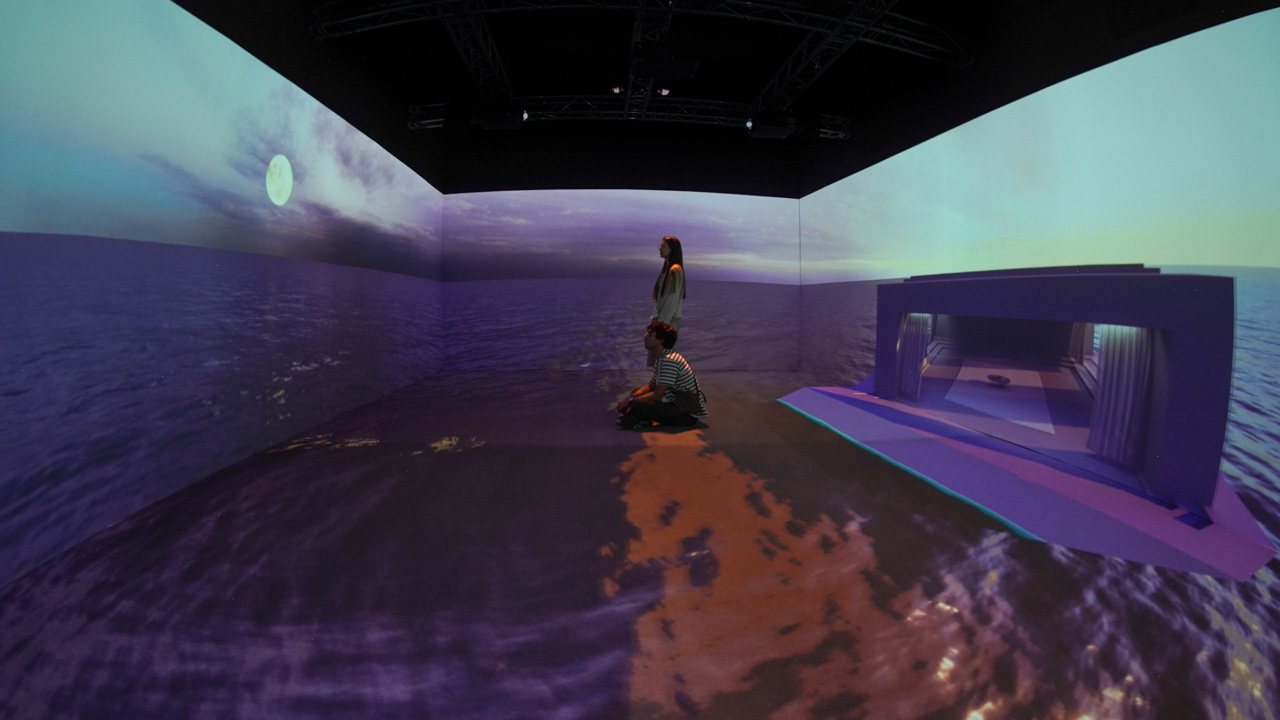
Video Projection Mapping
- Video projection mapping was the first technique used in the world of projection mappingIt consists in adapting a video, previously created by means of image recording or synthesis techniques such as 3D renderings, to a specific surface, such as a facade, a cardboard cube or even a face.
The Origin of Video Projection Mapping
- The oldest known example of projection mapping dates back to 1969, when Disney employed a rudimentary technique of 3D face mapping to bring the busts of the Haunted Mansion of Disney theme parks to life.
- Owing to a clever use of light, they were able to record on a 16mm film a head-shot of several actors singing the spooky theme song and the result was projected onto 5 busts known as the “Grim Grinning Ghosts”.
The Method of Video Projection Mapping
- This method, as brilliant and creative as it could appear, had nothing to do with technologies because the projected picture couldn’t be adjusted with advanced features like edge blending, warping, and color correction. Editing technologies had not yet been developed, the illusion had to be thought up and constructed at the time the film was shot.
Video Projection Mapping Techniques
- In this video we can see how to use the corner pin technique to adapt the video’s four corners to the four corners of the chosen surface. In this way, the characteristic optical illusion of a 3D mapping is achieved: the video seems to be part of the surface, or the surface seems to be a flat screen on which a video is played.
- Nowadays, we have the technologies to make this technique as complex as we want. In this project, for example, we used the projection mapping technique to simulate that the 1,500 circular containers were illuminated to form a single screen that showed information about our project for the Spanish Pavilion at World Expo 2012. In order to do so it is necessary to create masks in the shape of the object we want to animate.
Masking Techniques in Video Projection Mapping
- Masking techniques are essential in this discipline because they allow us to develop precise projections on irregularly shaped objects and surfaces. These methods include selectively hiding or exposing certain areas of the projected image, allowing the creation of complicated forms, shadows, and illusions.
- Masks can be used by video mappers to project images onto objects such as buildings, sculptures, or even human bodies, creating the illusion that the image is a part of the item itself.
Architectural Mapping in Video Projection Mapping
- On the other hand, architectural mapping can be implemented even to building facades. The surface of the facade can either be relatively small, like the 20-meter-long by 8-meter-high facade we worked with in the project for A-cero Arquitectos.
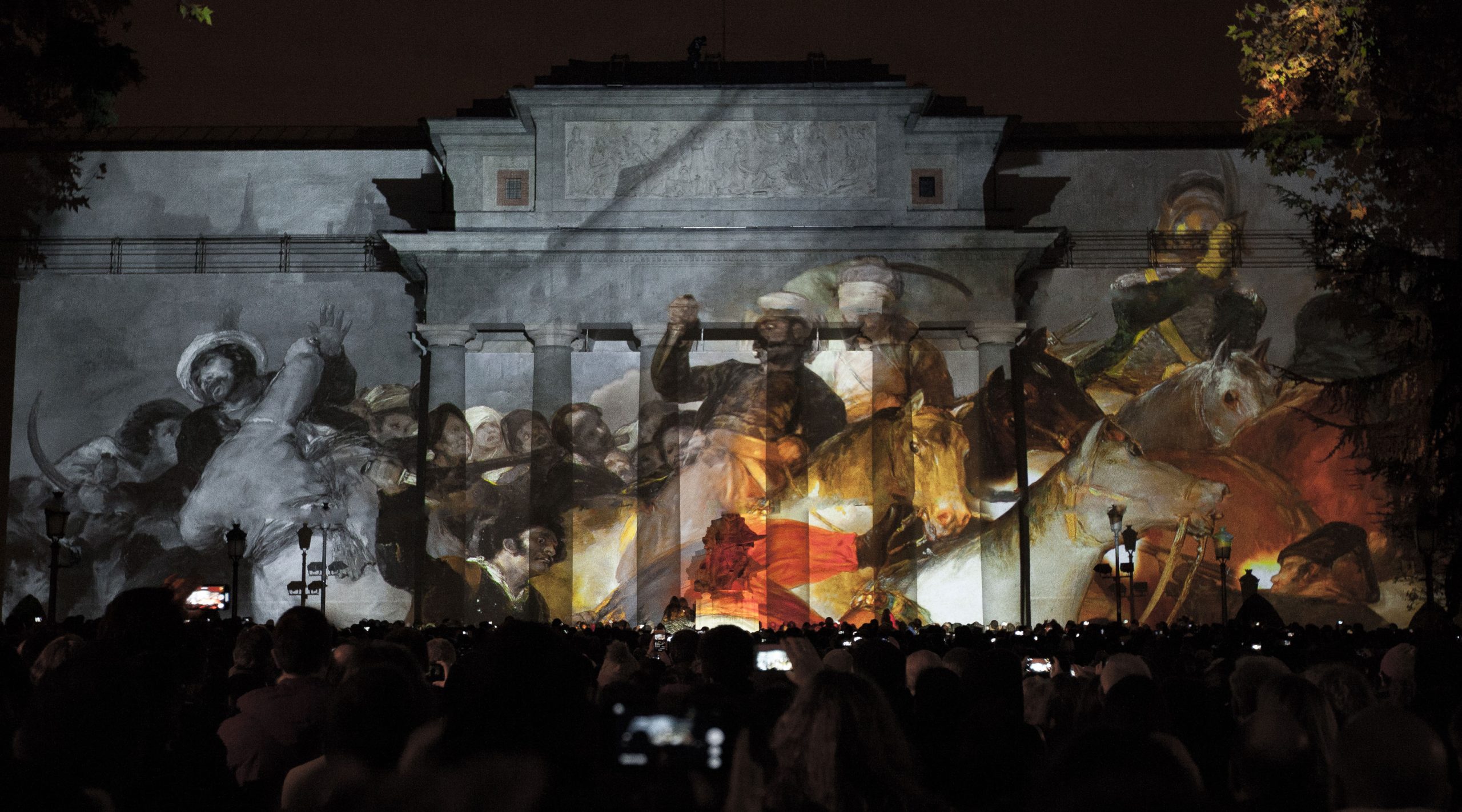
- But it is also possible to project video mappings onto very extended facades, as we did for the show celebrating the 200th anniversary of Museo del Prado. In order to do that the sum of multiple projectors of the right brand is required. We discussed more about this topic in this section of our blog.
3D Projection in Video Projection Mapping
- In our 3D projection Paradoxa playing with the concept of time-travelling. It was a part of this year´s edition of Solid Light Festival in Rome projected on Palazzo Eni building.
- Ontological paradoxes are situations that happen when travelling in time, causing contradictions. The predestination paradox occurs when a time traveller is trapped in a loop of events that predestines him to keep travelling in time. Paradoxa is a time journey that allows us to see and experience different moments in time, projected on a building facade.
The Implementation of Lasers in Video Projection Mapping
The implementation of lasers in projection mapping can significantly enhance the overall experience by providing an additional dimension of interactivity and visual appeal. The use of lasers adds a new layer of depth to the projections, creating mesmerizing displays that can captivate and engage audiences in new and exciting ways.
We have utilized lasers to great effect in our projects for the Museo del Prado and Palacio de la Magdalena. In these installations, we employed a combination of laser and projection mapping techniques to create a stunning and immersive visual experience.

Projection Mapping Companies for Events and Installations
When video mapping first started, it was limited to flat walls. Today, projection mapping companies like Onionlab use this technique can think far bigger and more creatively. They are no longer limited to structures or specific materials. Video mapping could also be applied to different surfaces of interior places such as shops, restaurants and different venue buildings.
Interactive visual
At Sonar +D Festival in 2019 we presented an interactive digital installation, DesigualinBeta, where projections played a huge role. We projected an interactive visual on a large canvas that reflected the audience’s actions and movements, generating light, colour and sound through the movements, behaviour and interactions between the participants.
Projection Mapping and Interactive Design for Events
Our design for the Spanish Pavilion at Expo Dubai 2020 is an impressive demonstration of the power of projection mapping and interactive design. The “Tree of Balance” installation invites visitors to engage with the exhibit by answering questions related to sustainability.
Based on their responses, the exhibit generates either a green or red drop on the 3D-printed tree, visually illustrating the impact of visitors’ habits on the environment. This interactive approach not only creates an engaging and immersive experience for visitors but also serves as a powerful educational tool, highlighting the importance of sustainable practices and environmental stewardship.
- Projection mapping has gained popularity as a powerful tool for creating immersive and memorable experiences that are more than just artistic or commercial in nature. By leveraging the power of technology and visual narrative, projection mapping can be implemented to raise awareness on a wide variety of important issues, from environmental preservation to social justice and beyond.